
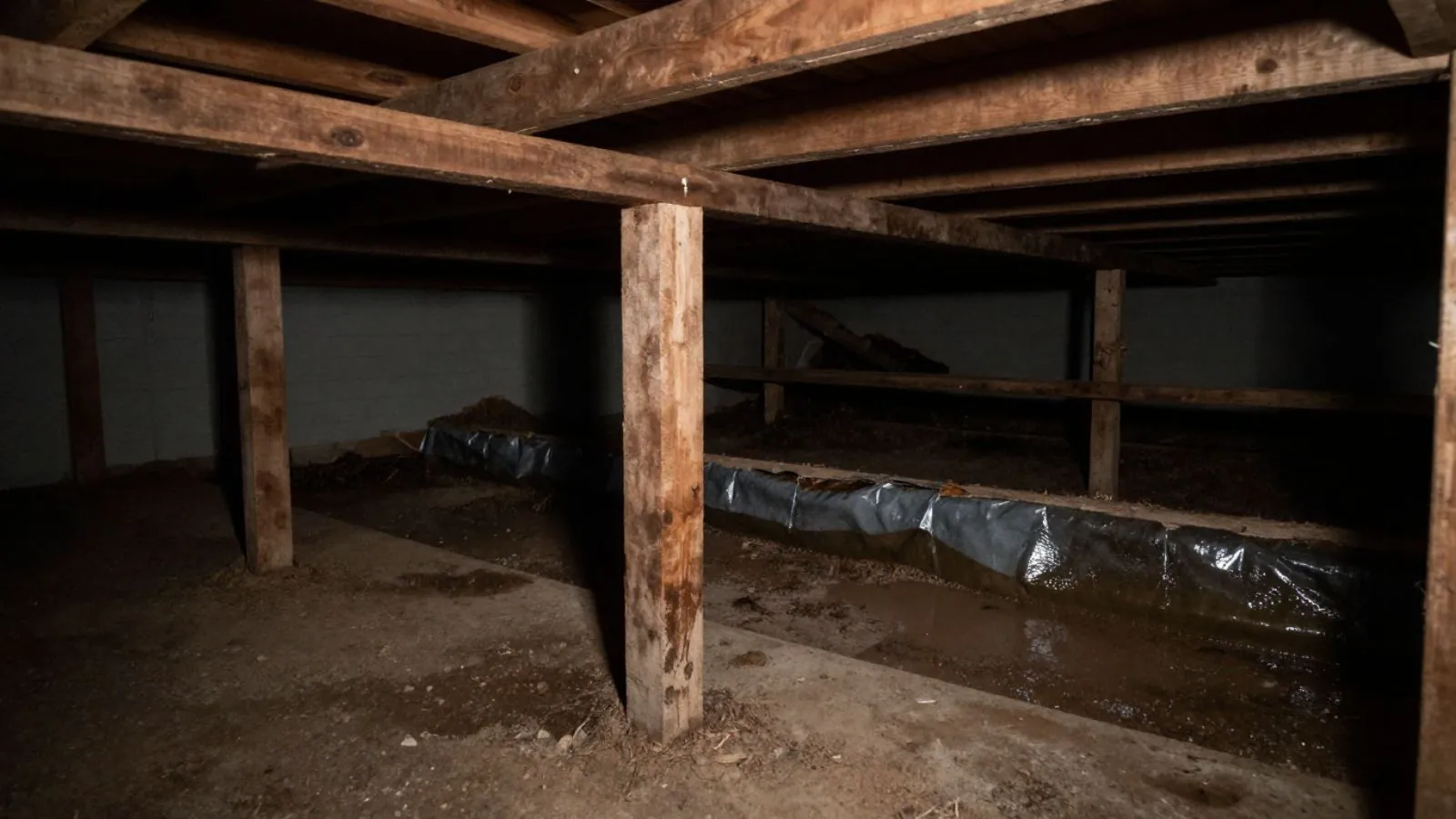
What water does under a house
A crawl space is dark and still. Water that gets in tends to stay. It soaks fiberglass insulation until it hangs down from the joists, raises the moisture content of the framing, and feeds mold on the underside of the subfloor. Wood that stays above roughly 20 percent moisture content for long periods can begin to decay.
How water gets into a crawl space
- Plumbing leaks. A supply or drain line running under the floor.
- Surface water. Rain running toward the foundation and through vents or the access door.
- Groundwater. A high water table after long wet spells.
- Irrigation. One caller in the regional call records had a crawl space flooded by a broken irrigation backflow device.
- Condensation. Humid summer air meeting cool ducts and joists.
Gardendale sits on rolling ground at about 669 feet with streams draining toward the Locust Fork, and many lots slope. A house on the low side of a street collects runoff at the uphill foundation wall. We cannot tell you how many local homes have crawl spaces, but the mid-century and later brick homes on established streets are where we would check first.
Signs you can spot without crawling in
- Musty odor that is stronger near floor vents.
- Hardwood floors cupping, or tile grout cracking.
- Higher indoor humidity and a sticky feel in summer.
- Insulation or a dark waterline visible from the access door.
- Rust on the bottom of the furnace or ductwork.
How cleanup works
- Inspection. Wood moisture readings on joists, beams and subfloor, and a look at what the water is and where it came from.
- Pump-out. Submersible pumps remove standing water.
- Removal. Wet insulation and a torn or silted vapor barrier come out.
- Cleaning. If the water was contaminated, surfaces are cleaned and treated.
- Drying. Air movers and a dehumidifier sized for the space run until the wood reads normal, typically 15 percent or below.
- Reinstatement. A new vapor barrier and insulation, once everything is dry.
What we handle and what we do not
| Need | Who does it |
|---|---|
| --- | --- |
| Pumping out water, drying wood, removing wet insulation | Us |
| Mold on joists and subfloor | Us, see mold remediation |
| Fixing the leaking pipe | A plumber |
| Regrading the yard, French drains, foundation waterproofing | A drainage or waterproofing contractor |
| Structural repair of rotted beams | A structural or framing contractor |
We say this plainly because callers sometimes expect a waterproofing system. Restoration is the cleanup and drying after water gets in. Keeping it out for good is a different trade.
What decides the price
Access and headroom, the size of the crawl space, the depth of water, how much insulation has to come out, whether cleaning or mold work is needed, and the drying days set the price. Scope and price are explained before work starts.
Insurance often covers a sudden pipe break under the house, while groundwater and surface water are usually treated as flood and need separate coverage. Check your policy. For a number on your crawl space, call (833) 521-1033.
Crawl space cleanup in Gardendale and around
We serve Gardendale 35071, Mount Olive, Fultondale, Morris and Kimberly. Larger wooded lots toward Mount Olive often have long crawl spaces to check. If the house has a full lower level instead, see basement water damage. The drying equipment is explained under structural drying.
Safety steps before anyone goes under the house
- Do not enter a flooded crawl space while power is on to equipment or wiring down there.
- Watch for snakes, sharp debris and low ductwork, and never crawl in alone.
- Wear a respirator and gloves where insulation is down or growth is visible.
Wood drying targets and methods follow the ANSI/IICRC S500 standard.